
A moissanite necklace can be a quiet everyday accent, a romantic gift, or a full statement of light. Because the stone is naturally eye-catching, thoughtful proportions matter: pendant size, chain length, setting height, and metal color should work together rather than compete.
This buying guide explains the main choices in plain language. Use it before browsing the VEZENY moissanite necklace collection.
Why Choose a Moissanite Necklace?
Moissanite is a distinct lab-created gemstone known for strong brilliance and colorful fire. It is highly scratch resistant and practical for frequently worn jewelry. A necklace also experiences less direct impact and abrasion than a ring, although chains, clasps, and prongs still need care.
Moissanite often provides a larger visual presence for the budget than diamond. That makes it useful for shoppers who want a noticeable center stone or a continuous line of sparkle without making diamond identity the priority. Read more about why moissanite appeals to modern jewelry buyers.
Choose the Necklace Style First
Solitaire pendants feature one center stone and are the most versatile. Halo pendants surround a center with smaller stones for added scale. Station necklaces space stones along the chain. Tennis necklaces create a continuous or near-continuous line of stones. Bar, cluster, initial, and symbolic pendants offer more graphic options.
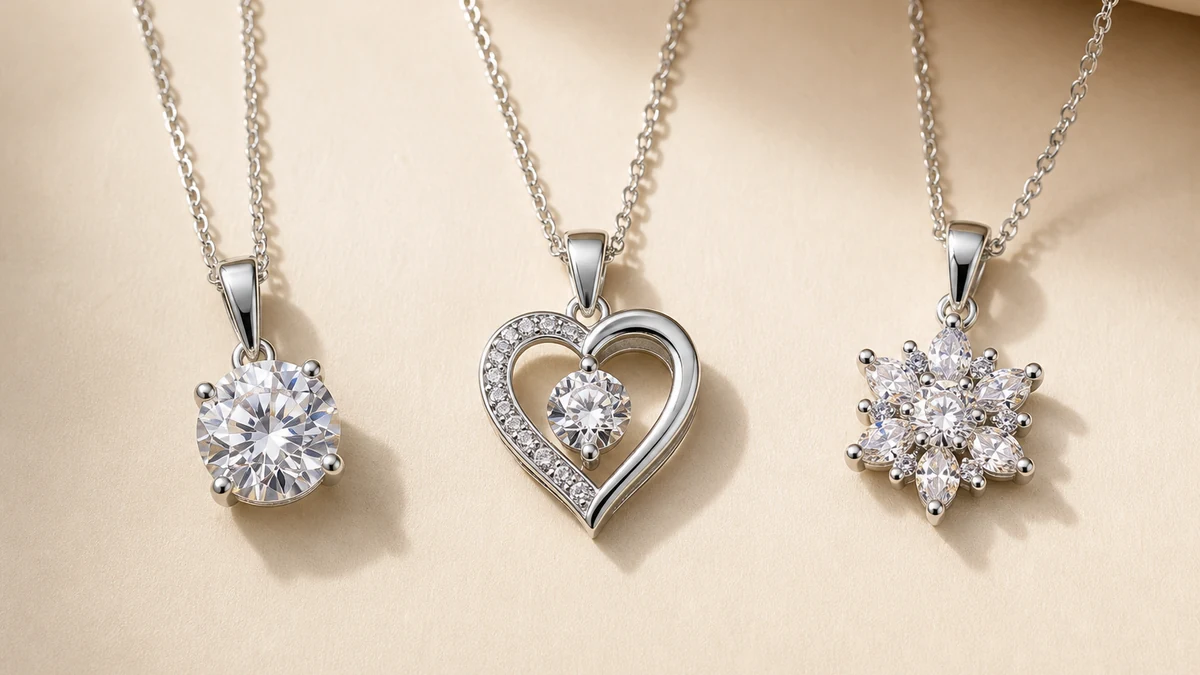
Think about use. A solitaire transitions easily from office to evening. A station necklace is excellent for layering. A tennis necklace has higher visual impact and requires close attention to flexibility, setting quality, and clasp security.
How to Choose Moissanite Size
Use millimeter dimensions to understand face-up appearance. Carat-equivalent descriptions can help with broad comparisons, but carat is a weight measurement and does not translate identically between gemstone materials.
For a solitaire, consider the relationship between stone and chain. A very delicate chain may look visually or physically mismatched with a large pendant. A small stone on a heavy chain can disappear. For multi-stone necklaces, total carat-equivalent weight reveals less than stone diameter, necklace width, and setting spacing.
Understanding Necklace Length
Common necklace lengths include approximately 16, 18, 20, and 22 inches, but the same chain rests differently depending on neck circumference, height, body proportions, pendant size, and clothing. Treat length charts as starting points, not guarantees.
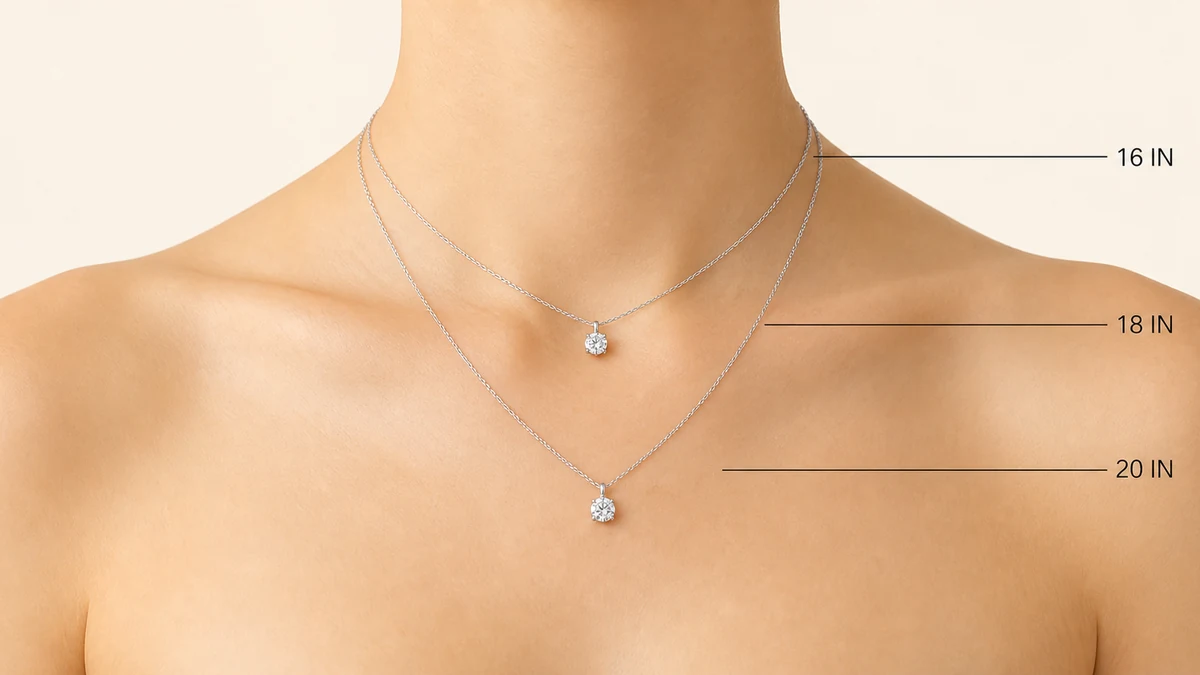
- 16 inches: often sits near the base of the neck.
- 18 inches: a widely versatile length for pendants.
- 20 inches: gives the pendant more breathing room and suits layering.
- 22 inches and longer: creates a lower focal point.
An extender adds flexibility. When gifting, an adjustable chain reduces the risk of choosing a fixed length that does not suit the recipient.
Prong, Bezel, and Halo Settings
Prongs hold the stone at several points and expose more of its outline. Four prongs look open; six prongs create a rounded frame. A bezel surrounds the stone with a rim of metal, producing a modern, smooth-edged appearance. A halo adds smaller stones around the center to increase apparent size and sparkle.
Setting height influences how a pendant lies. A low setting feels compact, while a tall basket may tilt more readily. Check the rear finish and the bail—the loop connecting pendant and chain. It should move smoothly without appearing too thin for the pendant.
Chain Style and Construction
Cable chains are classic and allow many pendants to remain the focus. Box chains have squared links and a crisp profile. Curb and rope chains are more visually present and can become part of the design. Thickness should support the pendant while preserving the intended look.
Some pendants slide freely; others are fixed to the chain. A sliding pendant can move and may help center itself, while a fixed pendant prevents the chain from passing through the bail but can shift if the chain rotates. Check whether the chain is removable, especially if you plan to swap lengths.
Metal Color and Material
White metal visually blends with colorless moissanite and emphasizes an icy look. Yellow metal creates warm contrast. Rose tones add softness. Beyond color, read the full base-metal and plating description because it determines care, potential refinishing, and price.
Sterling silver may tarnish and benefits from dry storage. Plated surfaces require gentle handling because the finish can wear. Buyers with known sensitivities should confirm the complete alloy and any coating.
How to Evaluate Necklace Quality
- The moissanite should be securely set and visually centered.
- Prongs should be even, smooth, and free from lifted edges.
- Links should articulate without kinks.
- The clasp should engage positively and match the necklace weight.
- Jump rings should be properly closed or soldered as designed.
- The pendant should hang in the intended direction without persistent flipping.
Choosing a Moissanite Necklace as a Gift
A solitaire in a moderate size and familiar metal color is the safest versatile option. Look at jewelry the recipient already wears: warm or white metal, delicate or bold scale, short or long chains. Symbolic pendants are more personal, while classic shapes require less guesswork.
Confirm chain length, adjustability, packaging, return terms, and whether the item is ready to gift. Accurate gemstone and material descriptions matter more than exaggerated comparisons.
Care and Storage
Apply lotion, perfume, and hairspray before putting on the necklace. Remove it before swimming, showering, exercise, or household cleaning. To clean, use warm water, mild dish soap, a soft brush, and a lint-free cloth. Rinse carefully and dry completely.
Lay chains flat or hang them separately so they do not knot. Fastening the clasp before storage can reduce tangling. Keep a tennis necklace supported rather than sharply folded. Follow the VEZENY jewelry care guide for more details.
Moissanite Necklace Buying Checklist
- Choose the intended use: everyday, layering, gifting, or statement wear.
- Compare stone dimensions and total necklace width.
- Select a length based on body proportions and neckline.
- Match chain strength to pendant size.
- Review setting, bail, clasp, metal, and plating.
- Check adjustability, warranty, and return terms.
Frequently Asked Questions
What is the best length for a moissanite necklace?
Eighteen inches is versatile for many pendants, but there is no universal best. Neck size, body proportions, neckline, and desired layering all change the ideal length.
Can I wear a moissanite necklace every day?
Yes, with routine care. Remove it for swimming, exercise, sleep if it may snag, and chemical exposure. Inspect the clasp and setting periodically.
How large should a moissanite pendant be?
Choose a size that balances the chain and intended look. Millimeter dimensions are the clearest way to judge visible scale.
Does moissanite sparkle like a diamond?
Both can be highly brilliant, but moissanite is a different gemstone and often shows more colorful fire. It should be appreciated and identified on its own terms.
Can a moissanite necklace be layered?
Yes. Separate chain lengths by roughly two inches, vary pendant scale, and avoid combining too many similarly heavy focal points.
Find the Necklace That Fits Your Life
Begin with how the necklace will be worn, then choose style, length, size, setting, and metal in that order. A well-balanced design will be easier to wear and enjoy. Explore VEZENY moissanite necklaces to discover your preferred level of sparkle.