
Choose amethyst if you prefer a purple accent, and citrine if you want a yellow-to-orange color direction. Both belong to quartz, but gemstone identity, treatment history and the finished setting still need to be read separately on a product listing.
Your wardrobe and preferred silhouette can be more useful starting points than a claim that one color is universally more flattering.
Compare the colors with clothes you actually wear
Try a purple gemstone image beside navy, gray or cream garments. Compare a golden stone with brown, beige or dark clothing. These combinations are starting points; your own preference is a better guide than a rigid skin-tone rule.
Check several images in understandable lighting. Screens and photography can shift color, and a seller’s representative image may not show the exact individual stone you receive.
You do not always have to choose one color
If you prefer one clear focal color, compare single-stone designs. If you enjoy a small palette, a mixed-gem piece may coordinate with more than one item in your wardrobe.
Ask about treatment without making assumptions
GIA explains that much market citrine results from heating amethyst. This general fact does not determine the treatment history of a particular item. Ask for the information known about your selected piece. See GIA’s citrine quality factors.
Similarly, do not interpret “natural” as a guarantee of no treatment. Read any specific disclosure rather than inferring processing from the color alone.
Use the whole design in your comparison
Compare gemstone dimensions, the overall pendant or ring size, and the surrounding accents. A small golden stone in an ornate frame can produce a different effect from a larger simple purple center.
For a ring, check fit and setting height. For a pendant, check chain length and how the outline sits against the intended neckline. Color is one decision among several.
Care requirements still matter
GIA describes warm soapy water as suitable for amethyst and citrine and cautions against heat and abrupt temperature changes. Follow the instructions for the complete jewelry item, especially where other gemstones, plating or treatments are present. See citrine care guidance.
A simple way to decide
- Pick the color you most want to wear.
- Check a second photograph or video.
- Compare the complete dimensions and construction.
- Confirm the selected gemstone and care information.
Explore a purple center or a choice of gemstone colors
These designs also differ in cutting style and motif. Compare those features as well as the color; the photographs are product examples, not color-calibrated measurements.
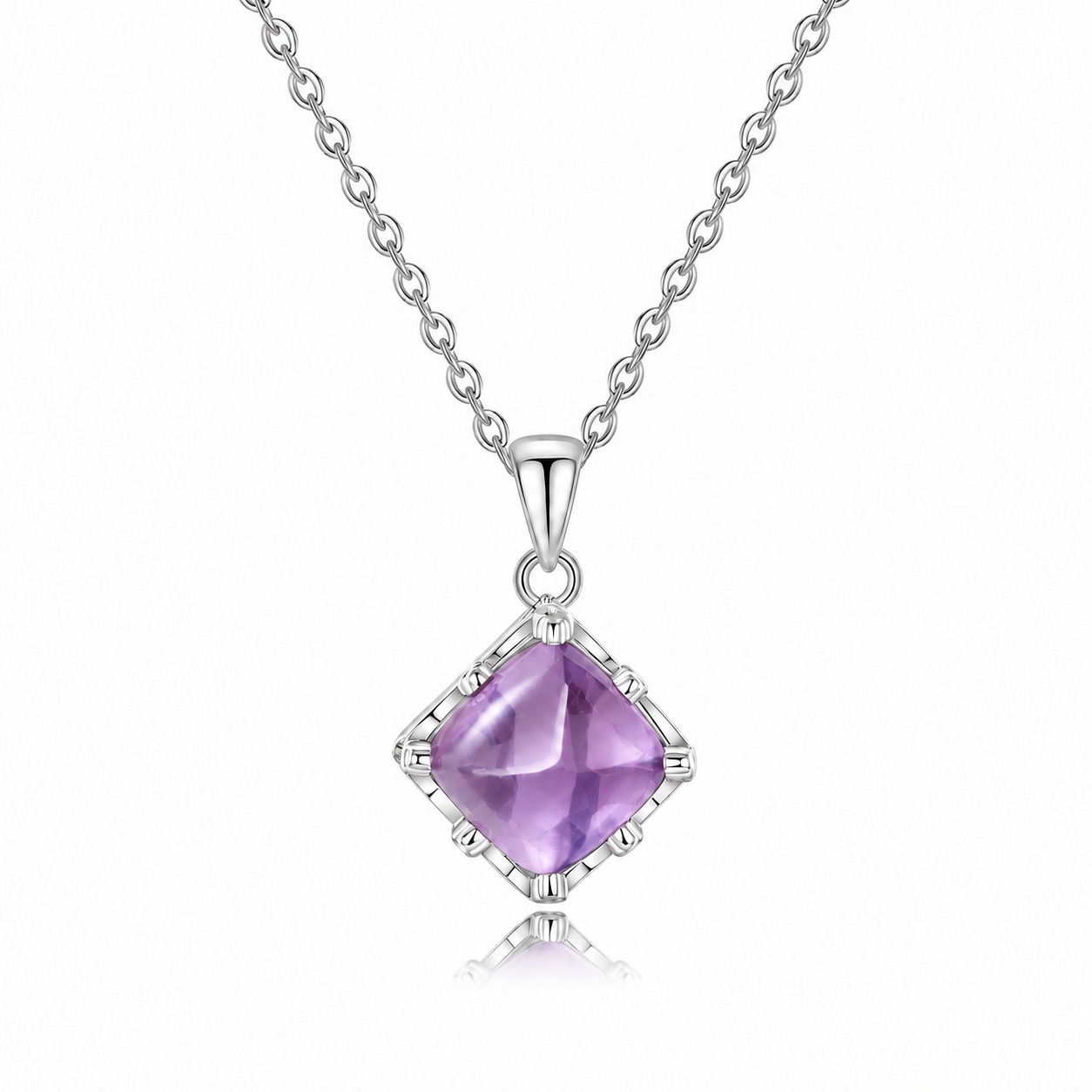
Cushion sugarloaf amethyst design
This listing uses an 8 mm amethyst and lets you choose Necklace, Ring or Earrings. The image shows the pendant, so select the intended item rather than assuming the whole coordinated collection is included. Its smooth raised center provides a different look from a faceted teardrop.
Brushed bow-knot teardrop necklace
The listing offers Amethyst and Citrine among its options, with a 6 × 8 mm center and an 18 × 28 mm pendant. The gallery displays several colors, which helps illustrate the choice without claiming every stone is included. Confirm the selected option and its known treatment information.

For more design choices beyond color, visit our everyday gemstone jewelry selection guide.