
Peridot stud earrings can give you one small green accent or a much more decorative front. To choose a pair, compare the amount of green, the whole earring dimensions and the attachment—not only a close-up of a gemstone.
Peridot’s green appearance is characteristic of the gem, but a green photograph cannot verify that a stone is peridot. Start with the seller’s written material description; GIA’s peridot overview provides background on the gemstone itself.
Your five-point comparison card
- Material: does the selected option explicitly say Peridot?
- Visible color: is the green a small accent, several centers or almost the entire front?
- Complete dimensions: how wide and tall is the earring, not just the gemstone?
- Attachment: what are the post and back details, and do they suit your piercing?
- Care: can you follow the instructions for the stone, finish and setting?
Choose geometry when you want the outline to do some of the work
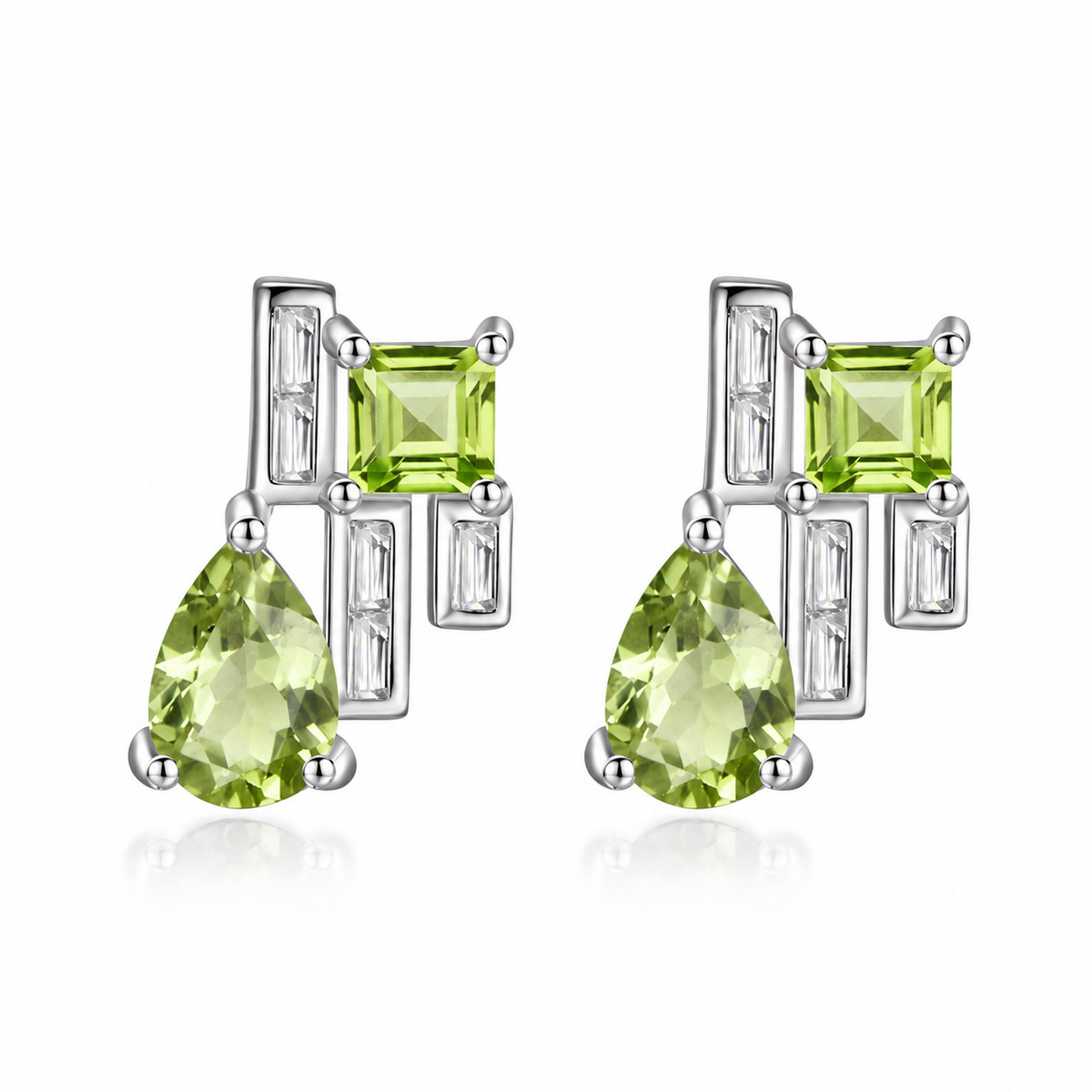
The mixed-cut geometric gemstone studs offer Peridot and list 12 × 9 mm overall dimensions, with 4 × 6 mm and 3.5 × 3.5 mm gemstone measurements. The complete outline is larger than either individual center. Compare the rectangle and pear arrangement with earrings you already wear rather than assuming “stud” means tiny.
This layout is also worth viewing as a pair in ordinary light. Look at the relationship between the green centers and the clear linear accents. Exact visual matching should be discussed with the seller if it matters to you.
Choose a repeated motif when you want a fuller patch of green
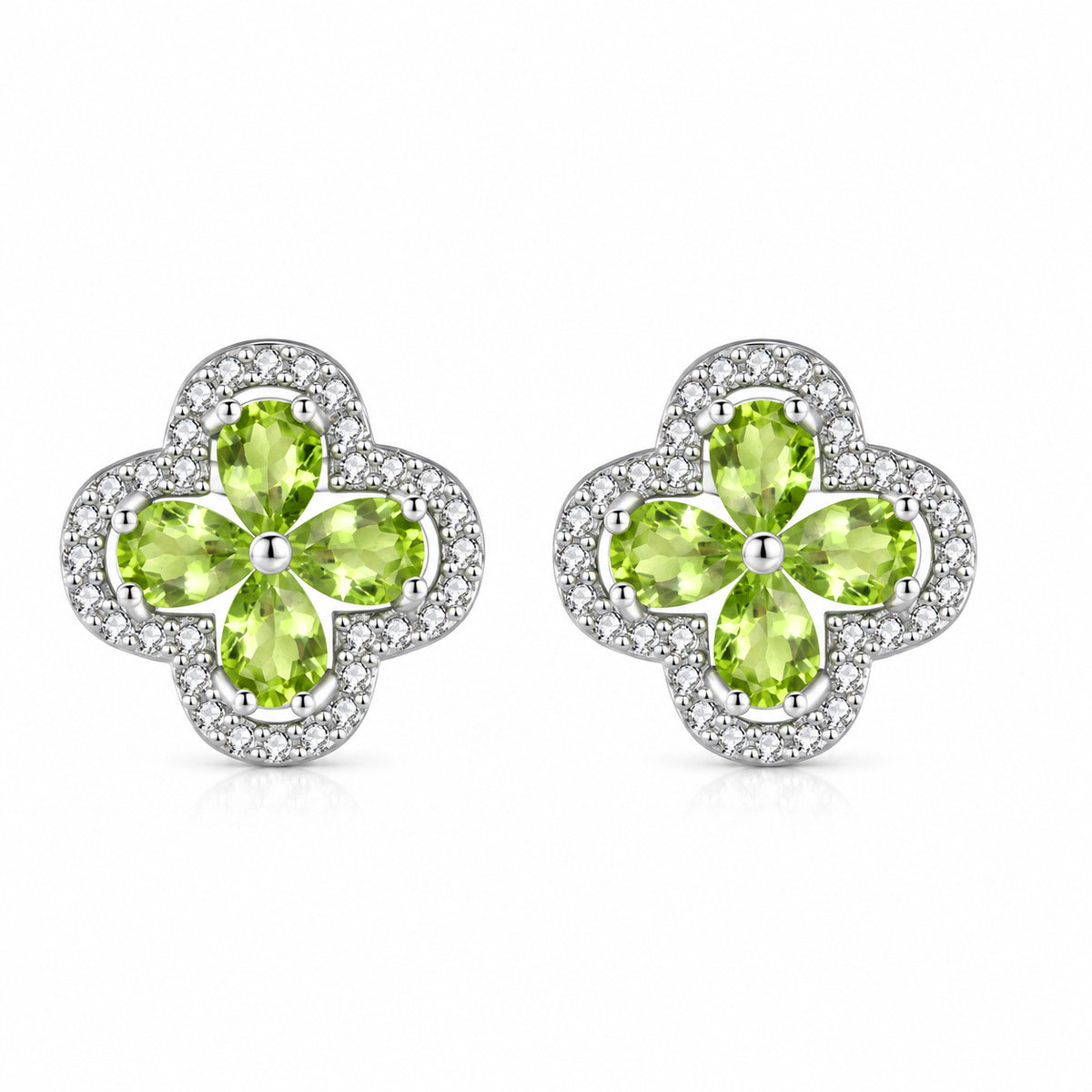
The four-leaf clover halo gemstone earrings offer Peridot and list 13 × 14 mm overall dimensions with 3 × 4 mm gemstones. The product title calls them drop earrings, while the main image shows the decorative fronts. Ask for the actual fastening and side view rather than assigning a closure from the title or face-up photo.
Compared with the geometric design, the clover occupies a broader outline. That is a style distinction, not a claim that one pair will be heavier, more comfortable or better fitting for everyone.
Check the metal as carefully as the gemstone
Compare the front against a pair you already own
Measure the width and height of a familiar earring, then draw the candidate’s full outline on paper. This will not reproduce its weight or the way it sits, but it can show whether a 13 × 14 mm motif is substantially broader than your usual pair. Note the position of the post as well: an equal overall height can sit differently if more of the design hangs below the piercing.
If you wear glasses, check the likely space between the frame arm and the earring. If you use a second piercing, compare the spacing with the whole front rather than just the individual gemstone. A seller’s side view is especially useful for these questions.
Both listings describe sterling silver. If you have metal sensitivities, request information about the alloy, plating, posts and backs. A gemstone name or a general “hypoallergenic” statement is not enough to promise that a particular wearer will tolerate the piece.
Ask whether a listed weight refers to one earring or the pair if weight is important to you. Where post length or thickness is not listed, obtain those measurements before ordering rather than guessing from a photograph.
Give the pair a realistic place in your routine
Peridot jewelry needs appropriate care; see GIA’s peridot cleaning guidance before choosing cleaning equipment. Keep earrings separate in storage, secure their backs and avoid treating a small gemstone as an indestructible one.
For a broader silhouette comparison, read our gemstone earrings guide. Then return to the five checks above with the particular pair you want to order.