
When buying blue topaz earrings, compare the two earrings together. Separate close-ups can make each center look attractive while giving you little evidence about how the pair relates in color, size and overall appearance.
You are not looking for two photographs with identical pixels. You want a pair whose differences do not distract you at the distance and in the light in which you will wear it.
Ask for a view that answers the matching question
Request a photograph of both selected earrings on the same neutral background, at the same angle and under one light source. If the seller can provide a short video, ask for the pair to turn together. Avoid comparing one tilted stone with one facing the camera.
Topaz can display different colors in different crystal directions, as described in GIA’s topaz overview. Reflections and the surrounding setting can also complicate the photograph. A difference in one frame is a reason to look again, not enough to diagnose a mismatch or identify treatment.
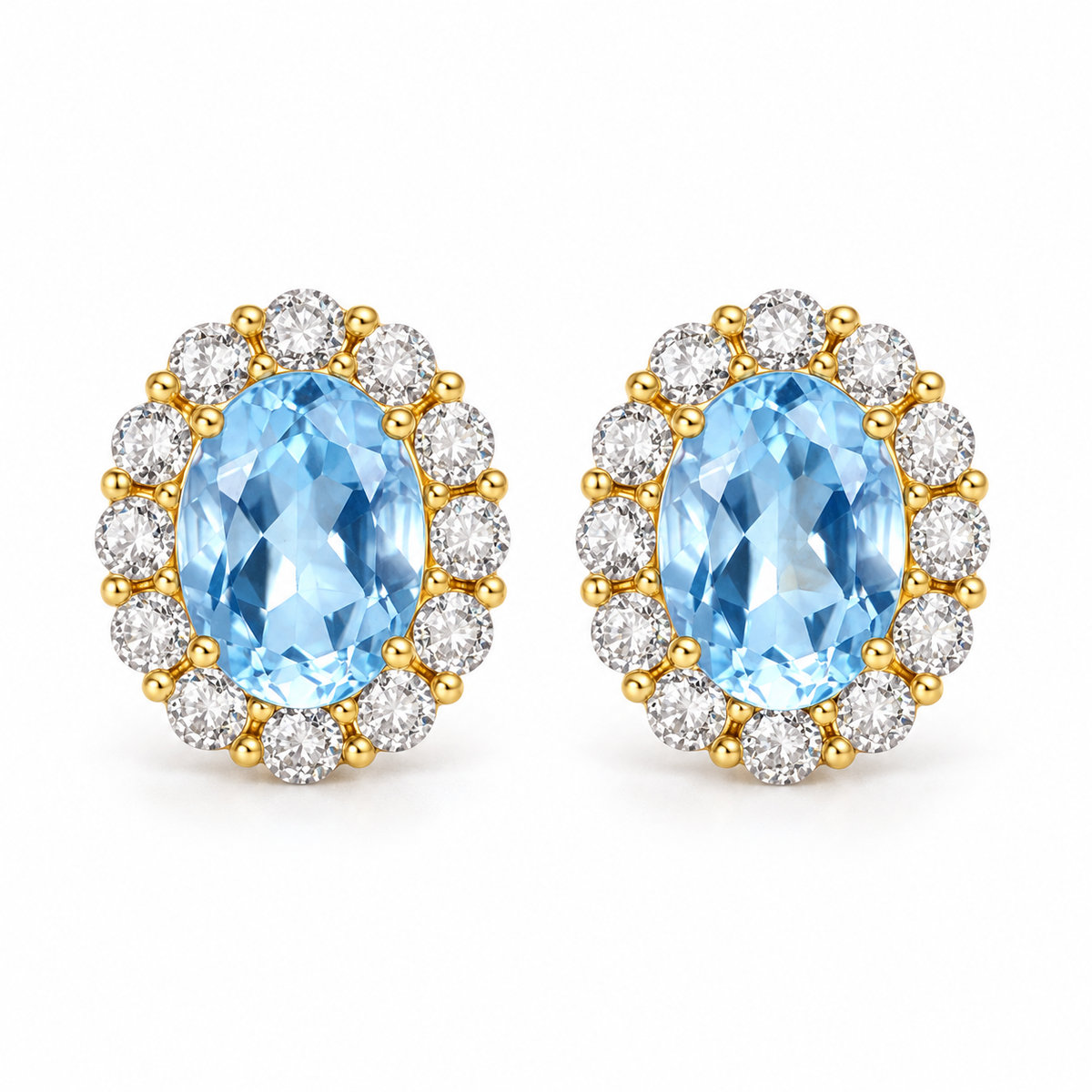
The oval halo frame gemstone earrings offer Blue Topaz and list 5 × 7 mm centers within an 8 × 10 mm overall outline. The image shows a light-blue option with decorative framing. Evaluate the blue centers separately from the clear accents and the surrounding metal color.
A simple observation sheet
| Check | What to compare | What not to assume |
|---|---|---|
| Blue tone | Do the centers look similarly light or deep when aligned? | A white background guarantees accurate color. |
| Visible size | Do both centers and complete outlines look consistent? | The carat label describes the whole earring. |
| Movement | Do both stones remain appealing as the pair turns? | One dark area proves a defect. |
| Frame and finish | Are the halos and metal tones the intended pair? | Every gallery color is included. |
Consider designs containing more than one blue center
With a multi-stone pair, you may want to compare the color relationship within each earring as well as between the left and right pieces. Decide whether a slight tonal variation would bother you before checkout, and ask about the actual pair if exact matching is important.

The oval gemstone hoop earrings have three oval centers along the front of each hoop and include a Blue Topaz option. The listing gives 3 × 5 mm gemstone dimensions. Ask for the hoop’s overall dimensions and the selected blue pair if those details affect your choice; the gemstone size alone does not establish the fit of the hoop.
Check the pair after delivery
A practical way to describe a concern
Instead of telling the seller that one earring is simply “wrong,” describe the conditions and the difference. For example: both earrings were aligned on a white card, photographed together in indirect daylight, and the same center continued to look darker after their positions were exchanged. Add a photo that preserves that comparison.
That is an observation, not a laboratory conclusion. It helps the seller decide whether to provide another view, explain a variation or discuss an exchange. Avoid editing one side of the photo independently, because a corrected exposure or color adjustment would remove the common reference.
Before removing any return tags, compare both earrings in ordinary indirect daylight and in the room where you usually dress. Keep them aligned, then switch their positions to see whether a difference follows the earring or the light. Follow the seller’s inspection and return conditions.
If the issue remains, photograph the pair together and contact the seller with the option and order details. Do not try cleaning, polishing or modifying a new pair to correct a color concern before discussing it.
For silhouette choices, use our existing studs versus drop earrings guide. Color matching is a separate decision: settle the pair you like, then check its dimensions, fastening and material information.